
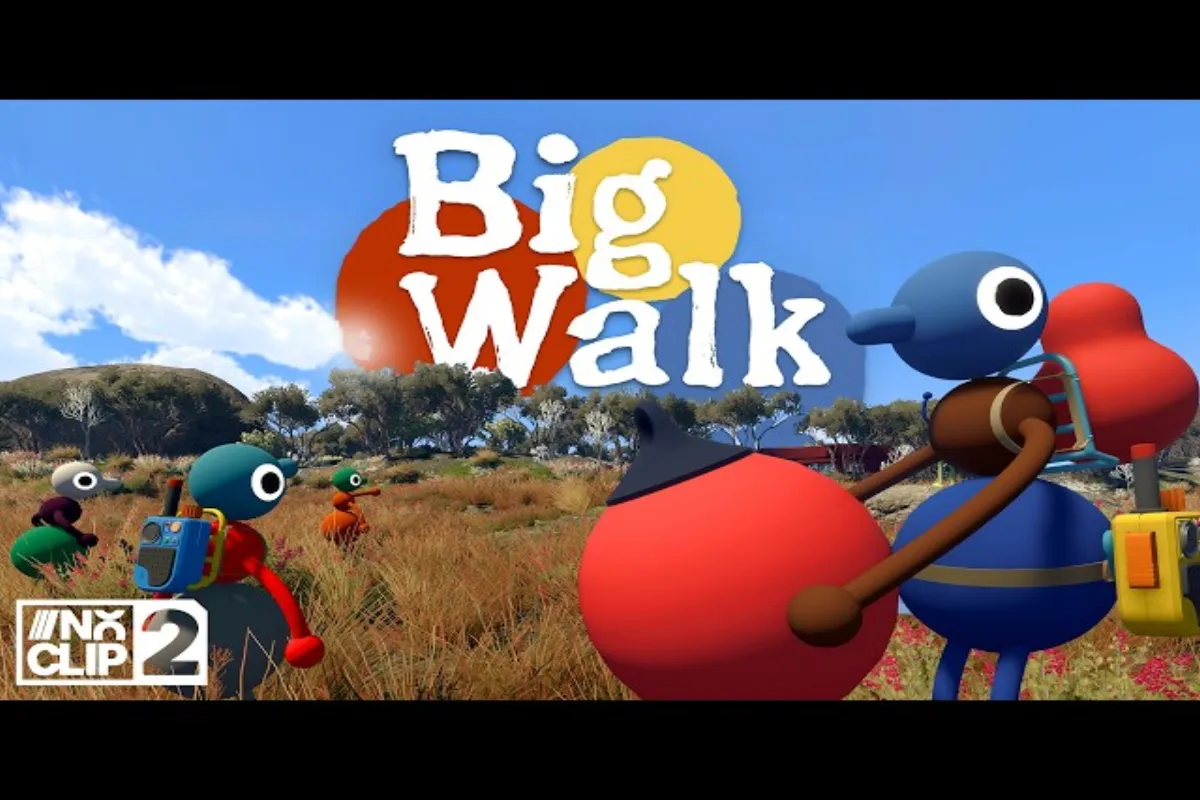
Big Walk drops players into a sun-soaked Australian bushland that feels less like a level and more like a postcard, and understanding exactly what the Big Walk environment inspired by reveals why every co-op adventure feels so grounded. From real-world research trips to Wilsons Promontory to the hand-placed landmarks that guide your group of 2–12 hikers, this is the wild corner of Victoria you keep stumbling back into.
The Real-World Roots of Big Walk's Bushland Setting
House House, the Melbourne studio behind Untitled Goose Game, spent roughly six years developing Big Walk, and most of that time went into making the bushland feel authentic rather than procedurally generated. According to the official Big Walk presskit, the world is directly inspired by the real Australian landscape — bushland, coast, hills, and rivers — which means the mossy rocks, stringybark trunks, and squeaky sand beaches you'll walk across aren't pulled from a generic forest library. They're reflections of specific terrain the developers walked with notebooks in hand.
Australian Bushland and Wilsons Promontory
The strongest single reference point is Wilsons Promontory National Park, the southernmost tip of mainland Australia. A GamesIndustry feature on the development journey confirms the team made multiple research trips into the bush, photographing undergrowth patterns, granite tors, and the way light filters through eucalyptus canopies in late afternoon. You can see the payoff in how the Big Walk environment inspired by these trips reacts to your movement: grass bends underfoot, dirt paths fork around old fallen logs, and distant ridges fade into haze the way real coastal ranges do.
That grounded research also shows up in small details players tend to miss on a first run:
-
Eucalyptus and wattle canopies that cast shifting, dappled shadows rather than uniform green discs.
-
Granite boulder clusters that look weathered rather than sculpted, modeled after the Prom's iconic rounded tors.
-
Squeaky white sand beaches along the southern coastline, a signature Wilsons Prom feature that several players have called out by name in community posts.
-
River crossings with tea-tree stained water, where the bank flora switches from dry scrub to wet-paperbarks.
How the Landscape Mirrors the Real Prom
Rather than recreating the park tile-for-tile, House House distilled it into a curated co-op adventure space. Real Wilsons Prom is enormous — over 50,000 hectares — and a faithful 1:1 map would bury the puzzles. Instead, the designers pulled the texture of the place and stretched it into a tighter, walkable region. The result is a world where every ridge, beach, and clearing feels like it could belong on the Prom's Mount Oberon ascent or the Squeaky Beach boardwalk, even when no single landmark is an exact replica.
| Real Wilsons Promontory Feature | In-Game Equivalent | Player-Noticeable Detail |
|---|---|---|
| Squeaky Beach white sand | Southern coastline strips | Footsteps produce a soft, bright crunch tone |
| Mount Oberon granite summit | Curved ramp lookout areas | Highest vantage point with 360° bush views |
| Tidal River tea-tree flats | River crossing puzzle zones | Water shifts from clear to amber-brown |
| Eucalyptus forest canopy | Most inland zones | Dynamic shadow patches that rotate with sunset |
| Coastal heath scrub | Ridge and cliff edges | Low pink and yellow wildflower clusters |
Iconic Big Walk Landmarks Worth Discovering
The world is packed with hand-placed landmarks that act as both navigation aids and puzzle anchors. According to the presskit, key landmarks include sound shrines, treehouses, a jungle gym, an ocean zone, curved ramp notes, and distinctive yellow boulders that you can spot from a surprising distance. Because Big Walk is built for 2–12 players using proximity voice chat, these landmarks double as natural regrouping points — if you've ever lost a buddy in the bush, climbing onto a yellow boulder is a reliable way to wave everyone back in.
Sound Shrines and Treehouses
Sound shrines are small wooden structures tucked into hollows, often near water. Activating them with the right cooperative trigger plays a sustained tone that can be used to communicate across valleys — a feature that makes them feel less like a collectible and more like a piece of the world's nervous system. Treehouses, on the other hand, are vertical landmarks usually perched on the edge of a clearing. Climbing one gives your group a bird's-eye view of the surrounding bushland and is often the easiest way to spot a distant yellow boulder or the next puzzle area.
Players exploring the full map will find that these landmarks aren't randomly scattered; they form loose clusters that hint at where the next chapter of the cooperative adventure is heading. If you want a structured overview of where everything sits, the Big Walk world map guide lays out the major landmark regions with rough coordinates.
Ocean Zone, Jungle Gym, and the Yellow Boulders
The ocean zone sits along the southern edge of the playable area and is the most visually distinct region in the entire game. Instead of bush, you get open water, salt-spray haze, and a wide horizon that the developers clearly built to reward players who push toward the map's perimeter. Inland, the jungle gym is a surprisingly playful landmark — a wooden climbing structure that invites one player to scramble up while others pass tools upward, which fits the game's tight focus on creative communication.
The yellow boulders are arguably the most charming piece of world design in Big Walk. Painted in a sun-bleached ochre that pops against the green bush, they're scattered along ridge lines and creek beds, sometimes forming a path, sometimes just sitting there as a wink to the player. Here's how the landmark categories compare for navigation purposes:
| Landmark Type | Best Use | Where to Find It | Co-op Role |
|---|---|---|---|
| Sound shrines | Long-range audio puzzles | Hollows near creeks | Signal across valleys |
| Treehouses | Regrouping and scouting | Ridge edges and clearings | Visual beacon for the group |
| Jungle gym | Vertical puzzle solving | Mid-bush zones | Pass tools upward |
| Ocean zone | Scenic regroup + finale hints | Southern map edge | Wide-spaced rally point |
| Curved ramp notes | Story progression | Hill crests and lookouts | Marks next chapter |
| Yellow boulders | Lighthearted navigation | Random clusters | Waypoint and visual gag |
For a region-by-region breakdown that pairs these landmarks with their puzzles, the Big Walk all locations guide is the next logical stop after this article.
Chasing the Perfect Big Walk Sunset
The day-night cycle in Big Walk is short on paper but enormous in mood. According to the presskit, nights are brief moments rather than prolonged darkness, and the game leans hard into the Big Walk sunset window where the sky turns copper, the eucalyptus silhouettes go black, and the granite tors catch one last orange highlight before the cycle resets. Because the adventure is built around forward motion and puzzle-solving, sunset is less a clock event and more a fleeting reward for the section you just finished.
How the Day-Night Cycle Works
Sunset doesn't trigger a fail-state or ambush; it simply rolls the world into a warmer palette for roughly 90 seconds of in-game time before night falls. Nights last only a few minutes before the sky brightens again, which means the developers expect players to keep moving rather than camp. The shorter night also reinforces the game's identity as a handcrafted co-op adventure with a clear ending — there isn't an infinite survival loop to grind, just a series of beautiful bush evenings to notice as you go.
Why Sunsets Hit So Hard
Several of the developers have spoken about how Wilsons Prom sunsets specifically influenced the color grading, and you can feel it. The sky doesn't just go orange — it goes a layered coral that fades to lilac at the zenith, with the distant ocean going almost navy. The yellow boulders, which were already vivid landmarks during the day, become nearly glowing at this hour, and sound shrines seem to ring out more clearly against the quiet. If you're chasing screenshots, the sunset window is the moment.
| Time of In-Game Day | Sky Color | Best Landmark to Photograph | Player Activity |
|---|---|---|---|
| Morning (first 25%) | Pale blue, misty valleys | Treehouses with dew drops | Group warm-up, sound shrine activations |
| Midday (25–60%) | High sun, harsh shadows | Ocean zone wide shots | Long ridge traverses, jungle gym puzzles |
| Late afternoon (60–85%) | Warm gold, long shadows | Yellow boulder clusters | Curved ramp note reading, prep for regroup |
| Sunset (85–95%) | Coral to lilac gradient | Ocean zone horizon line | Photo moment, final sound shrine chain |
| Brief night (95–100%) | Deep blue, bright stars | Inland sound shrines | Quick puzzle beats, headlamps on |
For tips on pairing sunset viewing with the best hidden areas, the Big Walk hidden areas guide highlights tucked-away lookouts that face directly into the western horizon.
How Environment Shapes Big Walk Gameplay
The Big Walk environment inspired by real bushland isn't just backdrop dressing — it directly drives the puzzle design. House House built the world so that the terrain itself is a tool: ridges block sightlines, creeks muffle sound, and tall grass hides smaller landmarks from a distance. Because the game relies on proximity voice chat and a small toolbox of communication items like a horn and a kazoo, every environmental feature either helps or hinders how your group coordinates.
Terrain as a Puzzle Mechanic
Most co-op puzzles in Big Walk require at least one player to be in a specific micro-location — a clearing behind a boulder, a treehouse platform, a stretch of beach — while another player triggers something on the opposite ridge. The bushland's natural sound dampening means your friend crouching in a gully 30 meters away might genuinely not hear your shouted instruction, which pushes groups toward the communication items built into the adventure. This is also why sound shrines feel so useful: they're the world's own solution to the dampening problem, letting a group extend their effective range.
Players report that the most satisfying Big Walk moments come from leaning into the environment rather than fighting it. Standing on a yellow boulder to signal, climbing a treehouse to spot the next ridge, or timing a sound shrine trigger to coincide with a sunset photo op — these are the rhythms that experienced groups fall into after a few hours.
Why the Bushland Setting Matters for the Co-op Pitch
The setting matters because it removes the usual co-op friction. There's no combat waiting to punish a misclick, no inventory management to trip over, and no enemy AI to split the group's attention. What you have instead is a beautiful, slightly inconvenient landscape that rewards patient communication — exactly the design lesson House House has been refining since the Untitled Goose Game era. The Big Walk open world hub of the Big Walk open world overview expands on how this connects to the broader adventure loop.
Tips for Exploring Big Walk's Bushland World
Whether you're planning your first expedition or returning for screenshots, a few habits will get the most out of the Big Walk environment inspired by Wilsons Promontory. The following checklist comes from community reports and early-player threads, not official patch notes, so treat it as field-tested advice rather than gospel.
-
Start with the southern coast. The ocean zone introduces every mechanic at a relaxed pace and gives your group the clearest Big Walk sunset window of the entire run.
-
Use yellow boulders as breadcrumb trails. If you're ever uncertain where the next curved ramp note sits, follow the nearest cluster — they almost always lead toward a story beat.
-
Trigger sound shrines before sunset. Their audio layering is noticeably stronger against the quiet of the sunset hour, and you'll get better group-wide communication for the next puzzle.
-
Climb every treehouse you pass. They double as scouting points and as photo opportunities, and they tend to sit near the trickier jungle gym or curved ramp sections that benefit from overhead planning.
-
Don't fight the dampening. If a teammate can't hear you across a creek, switch to the horn or kazoo — the game expects you to use these tools, and the design rewards it.
The deeper you get into the bush, the more the world rewards patience. Players who've spent multiple runs in Big Walk consistently report that the second playthrough feels richer than the first, because once you stop worrying about where to go, you start noticing the way the granite tors breathe in late afternoon, or how the stringybark shadows lean into the sunset. That's the kind of detail that doesn't survive procedural generation, and it's the clearest sign that the Big Walk environment inspired by real bushland is doing exactly what House House intended.
Got a favorite landmark or a sunset screenshot you're proud of? Drop it in the comments or share it with your group — the bush is more fun when everyone's trading tips.
Frequently Asked Questions
Q: Can I play Big Walk solo without other players?
While Big Walk is designed as a cooperative experience, you can explore the world solo. However, certain puzzles and areas require at least two players to complete, so solo walkers will find some content gated behind multiplayer requirements in the current version of the game.
What real place is the Big Walk environment inspired by?
The world is directly inspired by Wilsons Promontory National Park and broader Australian bushland. House House took multiple research trips to photograph eucalyptus canopies, granite tors, tidal flats, and squeaky sand beaches, then distilled those textures into a curated, walkable region rather than a 1:1 map.
What are the most important Big Walk landmarks to visit first?
Start with the sound shrines and the ocean zone, because both teach the core co-op loop without overwhelming new players. From there, work inland toward the treehouses and the jungle gym, which usually sit near the trickier puzzle clusters. The yellow boulders are worth tracking throughout, both as waypoints and as photo markers during the Big Walk sunset window.
How long does the Big Walk sunset last in-game?
Sunset lasts roughly 90 seconds of in-game time, followed by a short night that fades quickly into morning. The window is brief on purpose, because House House built the adventure around forward motion rather than camping. Use the moment to regroup, take photos, and line up the next sound shrine chain while the lighting is best.
Can you explore Big Walk's world after finishing the story?
Big Walk has a clear ending as a handcrafted co-op adventure, so there isn't a sprawling post-game open world in the traditional sense. That said, players can revisit earlier zones in subsequent runs, and many use the freedom to chase landmarks they missed or revisit the ocean zone specifically for.